In Word 2010 For A Mac What Does Banded Rows Mean
Add, change, or remove table shading. When a table has many rows and columns, it can be difficult to read. To make reading easier, you can add various types of shading to a table. For example, you can shade every other row with a color or pattern. In Word for Mac 2011, you can do any of the following. Add, change, or remove the shading. What you can do is create a new column over on the right side of your spreadsheet that you'll use to compute a value you can base your shading on. To control the colour of the bandings, change the Formatting scope ('Apply formatting to' from Whole Table to Odd Rows or Even Rows (or Columns if you want to set column banding). Then, click the Format button and choose Borders and Shading from the list of options. Office 2019, the new non-cloud version of Office for Windows and Mac, is now available to volume licence and commercial customers. This is the ‘cloud free’ or, as Microsoft call it the ‘on-premises’ version of Office desktop.
I prefer a combination of a good text editor (NotePad++ on Windows, BBEdit on OS X), plus a modern browser like FireFox or Chrome. The text editor is where you do the editing, while the browser parses the XML and finds any errors. You’ve already unzipped the document or presentation, now look for the XML portion that contains the error. Most of the time, with a Word file, document.xml will be the culprit.
• In Word 2007 and Word 2010, on the Home tab, in the Quick Styles gallery, right-click the thumbnail for the style you want to modify, and choose Modify. If the style you want to modify isn't showing there, see. • In Word 2002 and Word 2003, on the Format menu, click Styles and Formatting. Word will display the Styles and Formatting task pane.
@Michelle: The sumif formula in the article is written outside the table in a cell. If you write formulas in and copy (ctrl+c) and paste them, then the references are not changed.
Besides the Title style, the other zombie styles you’ll probably want to remove are: Subtitle Subtle Emphasis Emphasis Intense Emphasis Strong Quote Intense Quote Subtle Reference Intense Reference Book Title and List Paragraph Another useful edit you can make to styles is to change the number beside w:uiPriority. Decreasing this number moves a style up the list, while increasing it moves it down. You may have noticed that editing w:uiPriority in the w:latentStyles has no effect on the position of Normal style. See Custom Styles below to solve this. For all styles that have the same level number, they are displayed in alphabetical order. I usually rank them in the order they are likely to be used, with the body text and headings at the top, followed by bulleted, numbered and lettered styles.
After that, the host program starts generating automatic variants based on the theme. However, for the detail-oriented among us, manual recoloring of data series with custom colors is very convenient and miles above the previous technique, inputting RGB values from text. We’re here to do this for you, if you prefer!
Click the plus sign to add a row. Merging Cells and Splitting Cells To merge cells, drag your mouse over the cells while holding the left mouse button to select them. In the Layout tab, select the Merge Cells button from the ribbon. It looks like this: The Merge Cells button is located in the Merge group on the ribbon. Alternatively, select the cells you'd like to merge and click the right mouse button. Select the Merge Cells from the menu. To split a cell, select it by clicking on it, then click the Split Cell button on the ribbon. This button is also found in the Merge group. Choose the number of rows and columns you'd like to split the cell into then click OK. Split a table by clicking the Split Table button. It looks like this. Doing Math in a Table You can do math in tables in much the same way that you do in spreadsheets and Excel. However, Word's math commands are simpler, so they're easier to use.
By default (in Word 2016), the Top and Bottom margins are “0” and the Left and Right are “0.08”. These values might differ in earlier versions of Word. Enter new values for the margins, especially the Top and Bottom margins.
Result: formatting mistakes! The only way you can provide professional documents for clients is by making these visible so you can deal with them. When you want to see the printed result, do a Print Preview. It’s fast and more accurate than the “pretty” screen display. Useful View The exact steps for show the control characters is slightly different for each version of Word, so I’m not going to list them all here. To start in OS X, look for Word>Preferences>View, in Windows, choose File>Options>Display. Make all the non-printing or formatting characters visible.
Click the thumbnail of the style you want to apply it to the selected text. This tells Word whether this paragraph is the title, body text, a heading, a caption, or a paragraph with another function. If you don't like these methods, there are lots of other ways to • Second, tell Word how you want this style formatted. For example, as a default, Word sets Heading 1 as Arial, 16pt, Bold.
The BBEdit programmers have written a script to format XML in human-readable form. You can download it from here, please be sure to read the installation instructions first: Here’s your working procedure: • Open your Office file in BBEdit 11 or later. In the left-hand pane, you’ll see a folder tree of the files contained within, so no unzipping is required • Select the file you want to edit.
 Performance tests are conducted using specific computer systems and reflect the approximate performance of Mac mini.
It appears that the program omits the closing fallback tags when saving and you get the error. It’s not your fault, but Microsoft has not been able to find and eliminate this bug since the 2007 version. Posted in,,,, . Are you managing styles in your Word documents? A hallmark of a professionally-created template is the appearance of the Quick Style Gallery.
Often you’ll have styles that serve a function in a Word file, like unique styles that are referenced by StyleRef fields. If the user doesn’t need to apply a style, hide it. The simpler you make their interface, the fewer mistakes they can make. The styles/stylesWithEffects XML parts contain a list of exceptions. There are many styles that remain invisible until you add an exception to the list. As an example, if you want to make the Body Text style to be at the left end of the Quick Style Gallery, you would first copy and paste the exception for Normal, then change the name to Body Text.
You can then choose to: • Insert Columns to the Left • Insert Columns to the Right • Insert Rows Above • Insert Rows Below • Insert Cells In addition, you can also select a cell, row, or column, then go to the Table Tools Layout tab. Choose an option from the Rows & Columns group. You can also add rows or columns simply by mousing over a row or column. Look at the snapshot below. When we moused over the row, look at the little plus sign that appeared.
If her words, thoughts or pictures have helped you, or made money for you, then please consider making a donation in her name to the.
Click on the Layout tab at the top, then click the Select item. From the Select menu, choose Select Column: Your table will then look like this: To delete the column, make sure the Layout tab is selected at the top of Word. Locate the Rows & Columns panel and the Delete item: Click on Delete to reveal the following menu: Select Delete Columns from the menu.
These are combinations of a style and direct formatting that you have used in your document. Word has not created new styles in your document (see Figure 1).
The creator of ShaunaKelly.com, Shauna Kelly, passed away peacefully on Wednesday November 16, 2011 after a long battle with ovarian cancer. If you are requesting permission to re-use any information on this site, then you may do so with appropriate acknowledgement of her work. If her words, thoughts or pictures have helped you, or made money for you, then please consider making a donation in her name to the.
Otherwise, there must be another setting somewhere overriding my column band settings that I need to turn off.
Now you know why this is a lame alternative. If you try this technique, you can always restore the clean file view by running: defaults write com.apple.finder AppleShowAllFiles NO killall Finder. BBEdit 11 now has the ability to open and edit Office files directly, avoiding all of the above hassle when editing in macOS. While older versions of BBEdit used Tidy to format text, that utility has been retired.
In Word 2010 For A Mac What Does Banded Rows Mean
What is an Excel table? Table is your way of telling excel, “look, all this data from A1 to E25 is related. The row 1 has table headers.
There are seven columns above. Columns are vertical. Using the Insert Table Dialogue Once again, we're going to move the cursor to the point in the document where we want the table to appear. Now go back to the Insert tab, click the Table button, and select 'Insert Table' instead of dragging your mouse over the boxes (which really represent cells, as we learned a second ago.) A dialogue launches in the center of your screen. It looks like this. From here you can select the number of rows and columns. In this example, there are going to 5 columns, and 2 rows.
You did this for the previous table. (Select the whole table using the Layout panel, then use the Alignment panel to centre everything.) Now that everything is nicely centred, we can increase the height and width of the cells. To do that, select your entire table again. Still on the Layout panel, locate the Cell Size panel: Change the Height to 1 cm and Width to 2.5 cm (in inches 0.4 and 1). Your table should now look like this: Now that we have all the text and numbers finished, we can apply a style. This is quite easy. Click anywhere inside of your table.
The easiest way to add colored shading to a table is to use the Shading option on the Table Design tab. Add or change shading in a table • Select the cells you want to change: • To select an entire table, click in the table, and then click the Table Move Handle in the upper-left corner. • To select a row, column, cell, or group of cells, click and drag your mouse pointer to highlight the cells you want. • On the Table Design tab, click the arrow next to Shading.
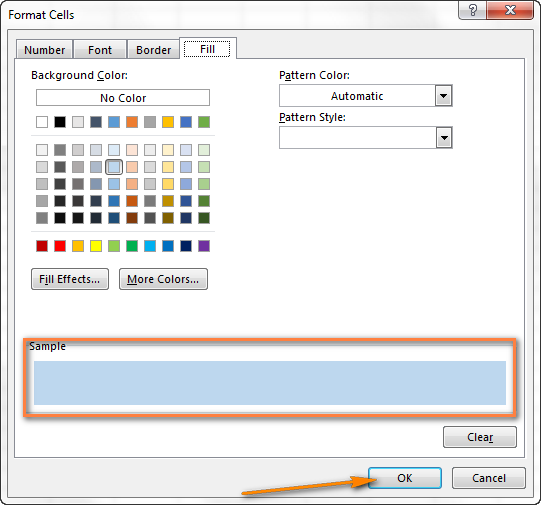
What you can do is create a new column over on the right side of your spreadsheet that you'll use to compute a value you can base your shading on. Let's say your new column is column D, and the value you want to look at is in column A starting in row 2. In cell D2 put: =MOD(IF(ROW()=2,0,IF(A2=A1,D1, D1+1)), 2) Fill that down as far as you need, (then hide the column if you want). Now highlight your entire data set - this selection of cells will be the ones that get shaded in the next step. From the Home tab, click Conditional Formatting, then New Rule. Select Use a formula to determine which cells to format. In 'Format values where this formula is true' put =$D2=1 Click the Format button, click the Fill tab, then choose the color you want to shade with.
The column or columns you have selected will then be deleted. (Note that from the Rows & Columns panel you can also add a new column to the left or right of the one you have selected.
Word does not allow these elements to be children of the trPr element. • “cnfStyle” is used in your document as child element of.
So the issue appears to be with your custom table style, called 'LightShading-Accent1'. Perhaps you tried to copy one of the default Word non-banded styles and customize it for your table style? The style appears to be working as designed because even in the UI it doesn't show any banded rows, whereas, 'ListTable1Light-Accent1' does. Your custom table style for the banded style behavior appears to manifest from some property in your custom table style that is applied further up the hierarchy. Perhaps you can use one of several Word table styles that display banded rows, and customize it from there? I hope this helps. Regards, Mark Miller Microsoft Open Specifications Team.
Users need to add and remove sections of the document to increase the relevance to the potential buyer. If you’ve used Microsoft Word for more than a few minutes, you’ve noticed that its documents are not modular in the least. Each section in a document is dependent on information from other sections. Even the trained Word users find it difficult to remove a Word section or set of pages without trashing the whole file. For some clients, this leads them down the wrong road. They notice that PowerPoint has great page modularity.